Effect of Indigenous Game on Selected Physical Psychological Variables of University Students
DOI:
https://doi.org/10.60081/SSHA.03.02.2025.538-543Keywords:
- Indigenous games,
- agility,
- balance,
- eye–hand coordination,
- attention,
- university students
Abstract
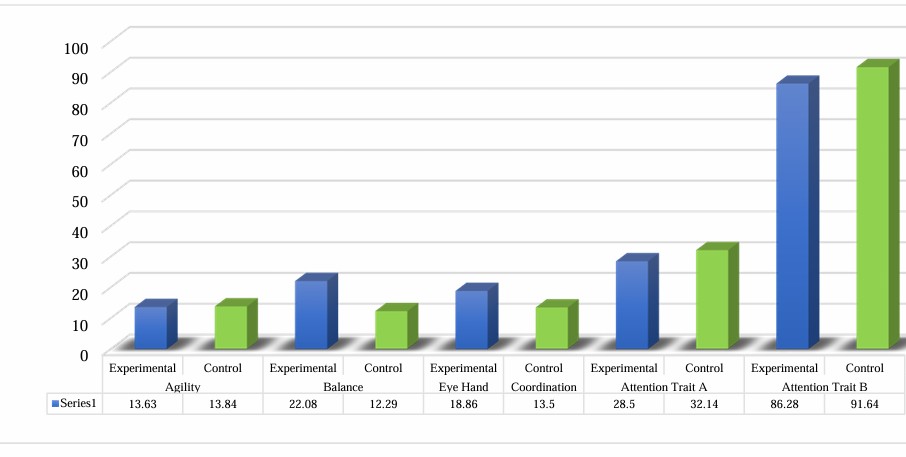
Purpose: This study aimed to investigate the impact of indigenous games on selected physical and psychological variables among university students. Background: Indigenous games have long been woven into the cultural fabric of Indian society, functioning as tools for physical fitness, cultural expression, and social interaction. Despite their relevance, their potential influence on contemporary student development in higher education remains underexplored. Material and Methods: Twenty-eight postgraduate students (aged 22–27 years) from the Central University of Punjab were recruited using purposive random sampling. Participants were divided into an experimental group (n = 14) and a control group (n = 14). The experimental group engaged in an 8-week structured indigenous games program featuring Pithu, Gilli Danda, Stapoo, Dog and the Bone, Kancha, and Buroinjin, while the control group received no intervention. Pre- and post-test data were collected using standardized assessment tools. Data analysis employed the Shapiro–Wilk test, Levene’s test, and ANCOVA at a 0.05 significance level. Results: The experimental group showed significant improvements in agility, balance, eye–hand coordination, and attention compared to the control group (p < 0.05). Effect sizes ranged from 0.79 to 0.91, indicating large and practically meaningful effects. Conclusion: Participation in indigenous games led to substantial gains in both physical and psychological parameters among university students. These findings highlight the effectiveness of indigenous games as culturally relevant, cost-efficient, and engaging alternatives to conventional training approaches in higher education.

Downloads
References
Anderson, S. E. D. (2007). Using the master’s tools: Resisting colonization through colonial sports. In C. King (Ed.), Native Americans and sport in North America (pp. 128–147). Routledge.
Best, J. R. (2010). Effects of physical activity on children’s executive function: Contributions of experimental research on aerobic exercise. Developmental Review, 30(4), 331–351.
Dart, J. (2017). Nation at play: A history of sport in India. Cambridge University Press.
Dhanjal, H. S. (2022). Indigenous games in India: Then & now. EPRA International Journal of Research and Development, 7(8), 198–201.
Fauzi, A., Rahman, M., & Abdullah, S. (2023). Traditional games as a medium to improve psychomotor performance and physical activity participation among students. Journal of Physical Education and Sport Sciences, 12(3), 145–154.
Irwin, J. D. (2004). Prevalence of university students' sufficient physical activity: A systematic review. Perceptual and Motor Skills, 98(3 Pt 1), 927–943. https://doi.org/10.2466/pms.98.3.927-943
Kaur, L., & Chander, R. (2015). Ancient Indian sports: A historical analysis. International Journal of Humanities, Arts, Medicine and Sciences, 3(1), 75–78.
Mohammadi Orangi, B., Ghadiri, F., Aghdasi, M., & Yaali, R. (2021). The effect of local indigenous games on motor proficiency in elementary school boys in Tehran with high and low emotional intelligence. Motor Behavior, 13(43), 85–100. https://doi.org/10.22089/mbj.2019.6435.1719
Nasim, M. A. (2019). A disappearance of traditional games by the imitation of colonial culture through the historical parameters of cultural colonialism. International Journal of Sport Culture and Science, 7(3), 1–12. https://doi.org/10.14486/IntJSCS.2019.577
Orangi, B. M., Ghadiri, F., Aghdasi, M. T., & Yaali, R. (2021). The effect of local indigenous games on motor proficiency in elementary school boys in Tehran with high and low emotional intelligence. Motor Behavior, 13(43), 85–100.
Orangi, S., Moradi, A., & Taghavi, M. (2021). Impact of indigenous games on motor proficiency and psychological attributes of university students. International Journal of Human Movement and Sports Sciences, 9(2), 45–52. https://doi.org/10.13189/saj.2021.090203
Sabzis, A. H. (2023). Agility development through traditional dodgeball training: An experimental study. International Journal of Physical Education and Sports Training, 15(1), 88–96.
Shliakhovchuk, O. (2019). Cultural literacy acquisition through video game environments of a digitally born generation (Doctoral dissertation, Universitat Politècnica de València). https://riunet.upv.es/server/api/core/bitstreams/6a16f0e8-cbb9-49ae-baae-3ebe9cd2abd8/content
Whitehead, M. E. (2010). Physical literacy: Throughout the lifecourse. Routledge.
Downloads
Published
Issue
Section
License
Copyright (c) 2025 Sanjeev Kumar, Tarun, Archit Singh, Mukesh Kumar Verma, Swati Choudhary

This work is licensed under a Creative Commons Attribution 4.0 International License.