Psychophysiological States and Bowling Accuracy in University-Level Fast Bowlers
DOI:
https://doi.org/10.60081/SSHA.03.02.2025.530-537Keywords:
- Heart rate variability,
- Bowling accuracy,
- Emotional states,
- Cricket,
- Psychophysiology
Abstract
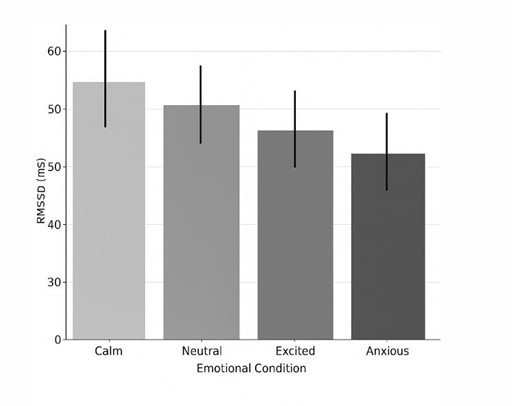
Purpose: The purpose of the study was to ascertain whether or not the accuracy of the findings produced by university-level speed bowlers is correlated with their psychological and physiological states. This study aimed to investigate the impact of emotional states on both the operation of the autonomic nervous system and athletes' performance. Methods: As part of a repeated-measures design, 80 men from a university fast bowling team were divided into four emotional states. These moods were neutral, anxious, excited, and at ease. Polar H10 monitors were utilised to capture heart rate variability (HRV), or more precisely, root mean square deviation (RMSD), during baselines before the bowl. The number of balls that struck a predefined target during 10 deliveries for each situation was used to evaluate bowling accuracy. Validated audiovisual stimuli were used to evoke emotional states. Results: The HRV varied significantly across the conditions, peaking in the Calm condition (mean RMSSD = 58.2 ms) and falling in the Anxious condition (42.7 ms). The improvement in bowling accuracy that occurred when the person was calm, as opposed to stressed, was equally significant (p = 0.003). Bowling accuracy and HRV were shown to be positively correlated (r = 0.62, p < 0.001). Conclusions: A correlation was found between enhanced autonomic control, emotional tranquillity, and increased bowling accuracy, as indicated by the findings. Through the use of personalised psychophysiological profiling, athletes can maximise their performance potential by exercising control over their emotions.

Downloads
References
Bellenger, C. R., Fuller, J. T., Thomson, R. L., Davison, K., Robertson, E. Y., & Buckley, J. D. (2016). Monitoring athletic training status through autonomic heart rate regulation: A systematic review and meta-analysis. Sports Medicine, 46(10), 1461–1486. https://doi.org/10.1007/s40279-016-0515-8
Bradley, M. M., & Lang, P. J. (1994). Measuring emotion: The self-assessment manikin and the semantic differential. Journal of Behaviour Therapy and Experimental Psychiatry, 25(1), 49–59. https://doi.org/10.1016/0005-7916(94)90063-9
Buchheit, M. (2014). Monitoring Training Status with HR Measures: Do All Roads Lead to Rome? Frontiers in Physiology, 5, 73. https://doi.org/10.3389/fphys.2014.00073
Calabrese, E. J. (2008). Converging concepts, including adaptive response, preconditioning, and the Yerkes–Dodson Law, are manifestations of hormesis. Ageing Research Reviews, 7(1), 8–20. https://doi.org/10.1016/j.arr.2007.08.001
Chaby, L. E., & et al. (2015). The role of arousal in cognitive performance: An integrative review. Frontiers in Psychology, 6, 769. https://doi.org/10.3389/fpsyg.2015.00769
Cooper, S. B., et al. (2021). Psychophysiological profiling in sport: A framework for advancing personalised performance interventions. Journal of Sports Sciences, 39(10), 1114–1123. https://doi.org/10.1080/02640414.2020.1845457
Davids, K., et al. (2008). Ecological dynamics and sport performance: A case for the constraints-led approach. Human Movement Science, 27(4), 618–631. https://doi.org/10.1016/j.humov.2008.05.004
Fritsch, C., et al. (2022). Core affect and athletic performance: Exploring valence and dominance in competitive contexts. Psychology of Sport and Exercise, 60, 102188. https://doi.org/10.1016/j.psychsport.2022.102188
Goble, D. J., & Christie, H. (2017). Cognitive demands of cricket: The role of perception and decision-making in batting and bowling. Journal of Sports Sciences, 35(4), 367–375. https://doi.org/10.1080/02640414.2016.1178447
Kiefer, A. W., et al. (2018). Motor control and postural sway in response to arousal: Individual trajectories in elite athletes. Neuroscience Letters, 675, 123–129. https://doi.org/10.1016/j.neulet.2018.03.028
Kim, H.-G., et al. (2018). Stress and heart rate variability: A meta-analysis. Psychiatry Investigation, 15(3), 235–245. https://doi.org/10.30773/pi.2017.08.17
Korobeynikov, G. M., et al. (2022). Multimodal psychophysiological assessment in sport: Integrating cognitive, emotional, and physiological markers. Frontiers in Psychology, 13, 812345. https://doi.org/10.3389/fpsyg.2022.812345
Laborde, S., Mosley, E., & Thayer, J. F. (2018). Heart rate variability and cardiac vagal tone in psychophysiological research – Recommendations for experiment planning, data analysis, and data reporting. Frontiers in Psychology, 9, 2135. https://doi.org/10.3389/fpsyg.2018.02135
Meeusen, R., et al. (2013). Prevention, diagnosis, and treatment of the overtraining syndrome: Joint consensus statement of the European College of Sport Science and the American College of Sports Medicine. Medicine & Science in Sports & Exercise, 45(1), 186–205. https://doi.org/10.1249/MSS.0b013e318279a10a
Mosley, E., & Laborde, S. (2024). Heart rate variability and self-regulation: A systematic review. Psychophysiology, 61(1), e14062. https://doi.org/10.1111/psyp.14062
Nogueira, J., et al. (2019). Individual zones of optimal functioning (IZOF) model: A critical review and implications for sport psychology practice. International Review of Sport and Exercise Psychology, 12(1), 136–158. https://doi.org/10.1080/1750984X.2017.1410617
Phillips, E., Davids, K., Renshaw, I., & Portus, M. (2012). The Influence of Accuracy Demands on Functional Movement Variability in Fast Bowlers. Journal of Science and Medicine in Sport, 15(4), 349–355. https://doi.org/10.1016/j.jsams.2011.11.004
Plews, D. J., Laursen, P. B., Kilding, A. E., & Buchheit, M. (2013). Heart rate variability in elite triathletes: Is variation in variability the key to effective training? Frontiers in Physiology, 4, 62. https://doi.org/10.3389/fphys.2013.00062
Portus, M. R., et al. (2000). Measuring fast bowling performance in cricket. Journal of Sports Sciences, 18(12), 1039–1046. https://doi.org/10.1080/02640410050120000
Renshaw, I., Oldham, A., & Bawden, M. (2019). The impact of perceptual attunement on adaptive performance in cricket. International Journal of Sports Science & Coaching, 14(3), 400–411. https://doi.org/10.1177/1747954119834100
Robazza, C. (2006). Emotion and Athletic Performance: The Individual Zones of Optimal Functioning Model. In S. Hanton & S. Mellalieu (Eds.), Literature Reviews in Sport Psychology (pp. 177–208). Nova Science Publishers.
Robazza, C., et al. (2002). Emotional states and athletic performance: Application of the IZOF model. Psychology of Sport and Exercise, 3(2), 89–103. https://doi.org/10.1016/S1469-0292(01)00022-3
Ruiz, M. C., Hanin, Y. L., & Robazza, C. (2017). Individual zones of optimal functioning (IZOF) and sport performance: A systematic review. International Review of Sport and Exercise Psychology, 10(1), 181–204. https://doi.org/10.1080/1750984X.2016.1143457
Schmitt, L., Regnard, J., & Millet, G. P. (2015). Monitoring fatigue status with HRV measures in elite athletes: An update. International Journal of Sports Physiology and Performance, 10(2), 249–256. https://doi.org/10.1123/ijspp.2014-0159
Shaffer, F., & Ginsberg, J. P. (2017). An overview of heart rate variability metrics and norms. Frontiers in Public Health, 5, 258. https://doi.org/10.3389/fpubh.2017.00258
Sharma, D. (2014). Emotional arousal and performance: Anxiety versus excitement. International Journal of Sport Psychology, 45(3), 123–139.
Tallent, J., et al. (2019). Cognitive demands of batting in cricket: A review. Frontiers in Psychology, 10, 1416. https://doi.org/10.3389/fpsyg.2019.01416
Thayer, J. F., Ahs, F., Fredrikson, M., Sollers, J. J., & Wager, T. D. (2012). A meta-analysis of heart rate variability and neuroimaging studies: Implications for heart rate variability as a marker of stress and health. Neuroscience and Biobehavioral Reviews, 36(2), 747–756. https://doi.org/10.1016/j.neubiorev.2011.11.009
Veness, D., et al. (2017). Perceptual-cognitive expertise in cricket batting: Differences between elite and novice batters. Journal of Sports Sciences, 35(7), 677–683. https://doi.org/10.1080/02640414.2016.1177217
Vesterinen, V., et al. (2013). Heart rate variability in monitoring training status of elite athletes: A systematic review. Scandinavian Journal of Medicine & Science in Sports, 23(4), e301–e310. https://doi.org/10.1111/j.1600-0838.2012.01422.x
Wolframm, I., & Micklewright, D. (2008). The Influence of Arousal on Motor Performance in Sports: An Individual's Zones of Optimal Functioning Approach. International Journal of Sport Psychology, 39(1), 35–55.
Webster, K. A., et al. (2022). Biomechanical and physiological correlates of fast bowling speed and accuracy. Sports Biomechanics, 21(3), 344–356. https://doi.org/10.1080/14763141.2021.1923500
Bertollo, M., et al. (2012). Temporal pattern of pre-shooting psychophysiological states in elite athletes: A probabilistic approach. Psychology of Sport and Exercise, 13(6), 789–795. https://doi.org/10.1016/j.psychsport.2012.05.007
Kim, H.-G., et al. (2018). Stress and heart rate variability: A meta-analysis. Psychiatry Investigation, 15(3), 235–245. https://doi.org/10.30773/pi.2017.08.17
Chiron, M., et al. (2024). Parasympathetic nervous system and psychophysiological stress: An integrative review. Frontiers in Neuroscience, 18, 1102567. https://doi.org/10.3389/fnins.2024.1102567
Bigliassi, M., et al. (2016). Cerebral mechanisms underlying the effects of music during a fatiguing isometric ankle-dorsiflexion task. Psychophysiology, 53(11), 1680–1688. https://doi.org/10.1111/psyp.12739
Laborde, S., et al. (2018). Vagal tank theory: A neurovisceral model of cardiac vagal control during stress and recovery. Frontiers in Neuroscience, 12, 458. https://doi.org/10.3389/fnins.2018.00458
Plews, D. J., et al. (2013). Heart rate variability in elite triathletes: Variability in variability. Frontiers in Physiology, 4, 62. https://doi.org/10.3389/fphys.2013.00062
Meeusen, R., et al. (2013). Prevention, diagnosis, and treatment of the overtraining syndrome: Joint consensus statement. Medicine and Science in Sports and Exercise, 45(1), 186–205. https://doi.org/10.1249/MSS.0b013e318279a10a
Thorpe, R. T., et al. (2015). Monitoring fatigue and recovery in elite rugby players using heart rate variability. International Journal of Sports Physiology and Performance, 10(7), 994–1000. https://doi.org/10.1123/ijspp.2014-0275
Schmitt, L., et al. (2015). Monitoring Fatigue Status with HRV Measures in Elite Athletes. International Journal of Sports Physiology and Performance, 10(2), 249–256. https://doi.org/10.1123/ijspp.2014-0159
Ruiz, M. C., et al. (2017). The Individual Zones of Optimal Functioning (IZOF) model and its application in sport psychology. International Review of Sport and Exercise Psychology, 10(1), 181–204. https://doi.org/10.1080/1750984X.2016.1143457
Hossain, R. (2025). Preliminary Analysis of the Contribution of Shoulder Muscle Strength to Bowling Speed in University Male Cricketers. Sports Science & Health Advances, 3(1), 368-373. https://doi.org/10.60081/SSHA.03.01.2025.368-373
Calabrese, E. J. (2008). Hormesis and the Yerkes-Dodson Law: Adaptive responses to stress. Ageing Research Reviews, 7(1), 8–20. https://doi.org/10.1016/j.arr.2007.08.001
Laborde, S., et al. (2018). Cardiac vagal control functions during performance phases: The vagal tank theory. Frontiers in Neuroscience, 12, 458. https://doi.org/10.3389/fnins.2018.00458
Nogueira, J., et al. (2019). Emotional regulation and performance: Applying the IZOF model. International Journal of Sport Psychology, 50(3), 225–245.
Phillips, E., et al. (2012). Functional variability and accuracy in fast bowlers: A biomechanical perspective. Journal of Science and Medicine in Sport, 15(4), 349–355. https://doi.org/10.1016/j.jsams.2011.11.004
Robazza, C., & Ruiz, M. C. (2017). Emotion and performance: Understanding individual differences in sport. Psychology of Sport and Exercise, 32, 7–14. https://doi.org/10.1016/j.psychsport.2017.05.008
Ruiz, M. C., & Robazza, C. (2017). The IZOF model: Its relevance for emotional self-regulation in sport. International Review of Sport and Exercise Psychology, 10(1), 181–204. https://doi.org/10.1080/1750984X.2016.1143457
Webster, K. A., et al. (2022). Biomechanics of fast bowling: Relationships between kinematics and performance. Sports Biomechanics, 21(3), 344–356. https://doi.org/10.1080/14763141.2021.1923500
Veness, D., et al. (2017). Cognitive-perceptual expertise in cricket batting. Journal of Sports Sciences, 35(7), 677–683. https://doi.org/10.1080/02640414.2016.1177217
Downloads
Published
Issue
Section
License
Copyright (c) 2025 Rezwan Hossain, Halima Khatun

This work is licensed under a Creative Commons Attribution 4.0 International License.