Association of Metabolic Syndrome with Pain Severity and Physical Functioning in Patients with Knee Osteoarthritis
DOI:
https://doi.org/10.60081/SSHA.4.1.2026.638-645Keywords:
- knee osteoarthritis,
- metabolic syndrome,
- pain severity,
- physical functioning,
- muscle strength,
- inflammation
Abstract
Background: Knee osteoarthritis (KOA) is a prevalent and debilitating musculoskeletal condition increasingly recognized as a metabolically influenced disorder. Metabolic syndrome (MetS)-encompassing obesity, hypertension, dyslipidaemia, and insulin resistance-has been implicated in the onset, progression, and symptomatic burden of KOA through both mechanical and systemic inflammatory mechanisms. Objective: This narrative review aimed to examine the association between metabolic syndrome and pain severity and physical functioning in patients with knee osteoarthritis. Methods: Studies published between 2001 and 2024 were reviewed, encompassing cross-sectional, longitudinal cohort and observational, case control studies. Key outcomes included pain severity, physical functioning, muscle strength, physical activity levels, and quality of life. Results: MetS was significantly more prevalent among KOA patients compared than in non-OA populations. A dose–response relationship was observed between MetS component accumulation and worse pain, functional decline, and disease progression. Elevated inflammatory markers, including IL-6, correlated with greater radiographic severity and disability. Conclusion: Metabolic syndrome significantly amplifies pain severity and functional impairment in KOA beyond mechanical loading alone. Integrated metabolic screening and multidisciplinary management are essential for optimizing patient outcomes.

Downloads
References
Puenpatom, R. A., & Victor, T. W. (2009). Increased Prevalence of Metabolic Syndrome in Individuals with Osteoarthritis: An Analysis of NHANES III Data. Postgraduate Medicine, 121(6), 9–20. https://doi.org/10.3810/pgm.2009.11.2073.
Coggon, D., Reading, I., Croft, P., McLaren, M., Barrett, D., & Cooper, C. (2001). Knee osteoarthritis and obesity. International journal of obesity and related metabolic disorders: journal of the International Association for the Study of Obesity, 25(5), 622–627. https://doi.org/10.1038/sj.ijo.0801585.
Sellam, J., & Berenbaum, F. (2013). Is osteoarthritis a metabolic disease? Joint bone spine, 80(6), 568-573.
Yoshimura, N., Muraki, S., Oka, H., Tanaka, S., Kawaguchi, H., Nakamura, K., & Akune, T. (2012). Accumulation of metabolic risk factors such as overweight, hypertension, dyslipidaemia, and impaired glucose tolerance raises the risk of occurrence and progression of knee osteoarthritis: a 3-year follow-up of the ROAD study. Osteoarthritis and cartilage, 20(11), 1217-1226.
Clockaerts, S., Bastiaansen-Jenniskens, Y. M., Runhaar, J., Van Osch, G. J., Van Offel, J. F., Verhaar, J. A. N., ... & Somville, J. (2010). The infrapatellar fat pad should be considered as an active osteoarthritic joint tissue. Osteoarthritis and Cartilage, 18(7), 876-882.
Wang, Huajun, Cheng, Yanmei, Shao, Decheng, Chen, Junyuan, Sang, Yuan, Gui, Tao, Luo, Simin, Li, Jieruo, Chen, Chao, Ye, Yongguang. Metabolic Syndrome Increases the Risk for Knee Osteoarthritis: A Meta-Analysis(2016) Evidence-Based Complementary and Alternative Medicine, 2016, 7242478,2016. https://doi.org/10.1155/2016/7242478
Samaan SF, Taha SI. (2022) The Impact of Metabolic Syndrome on Quality of Life Among Individuals with Knee Osteoarthritis Living in Egypt. Clinical Medicine Insights: Arthritis and Musculoskeletal Disorders. 15. doi:10.1177/11795441221097361
Niu, J., Clancy, M., Aliabadi, P., Vasan, R. and Felson, D.T. (2017), Metabolic Syndrome, Its Components, and Knee Osteoarthritis: The Framingham Osteoarthritis Study. Arthritis & Rheumatology, 69: 1194-1203. https://doi.org/10.1002/art.40087
Xie, D. X., Wei, J., Zeng, C., Yang, T., Li, H., Wang, Y. L., Long, H. Z., Wu, Z. Y., Qian, Y. X., Li, K. H., & Lei, G. H. (2017). Association between metabolic syndrome and knee osteoarthritis: a cross-sectional study. BMC musculoskeletal disorders, 18(1), 533. https://doi.org/10.1186/s12891-017-1890-9.
Alenazi, A.M., Alshehri, M.M., Alothman, S. et al. (2020) The Association of Diabetes with Knee Pain Severity and Distribution in People with Knee Osteoarthritis using Data from the Osteoarthritis Initiative. Sci Rep 10, 3985 (2020). https://doi.org/10.1038/s41598-020-60989-1.
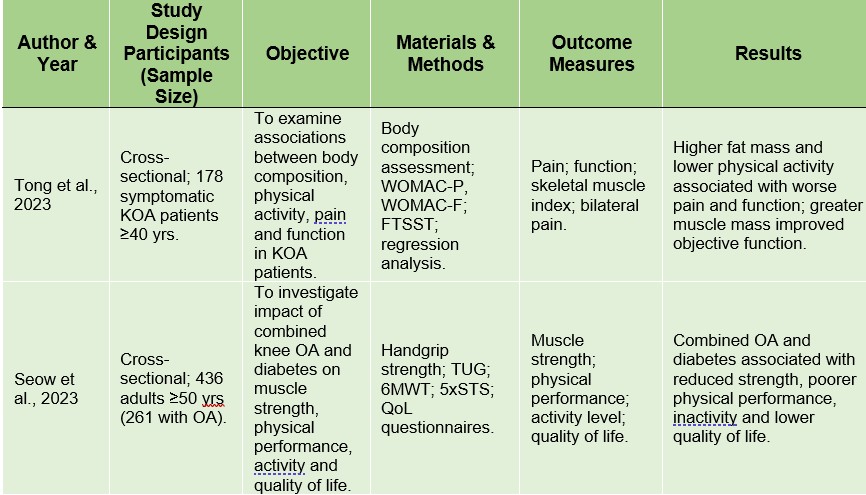
Tong, B., Chen, H., Wang, M., Liu, P., Wang, C., Zeng, W., Li, D., & Shang, S. (2024). Association of body composition and physical activity with pain and function in knee osteoarthritis patients: a cross-sectional study. BMJ open, 14(1), e076043. https://doi.org/10.1136/bmjopen-2023-076043.
Seow, S. R., Mat, S., Teoh, J. J., Mohamad Yusup, A., Rajab, N. F., Ismail, I. S., … Berenbaum, F. (2024). Combined knee osteoarthritis and diabetes is associated with reduced muscle strength, physical inactivity, and poorer quality of life. Journal of Rehabilitation Medicine, 56, jrm39986. https://doi.org/10.2340/jrm.v56.39986.
Li, H., George, D. M., Jaarsma, R. L., & Mao, X. (2016). Metabolic syndrome and components exacerbate osteoarthritis symptoms of pain, depression and reduced knee function. Annals of translational medicine, 4(7), 133. https://doi.org/10.21037/atm.2016.03.48.
Inoue, R., Ishibashi, Y., Tsuda, E. et al. (2011) medical problems and risk factors of metabolic syndrome among radiographic knee osteoarthritis patients in the Japanese general population. J Orthop Sci 16, 704–709.
Shin D. (2014). Association between metabolic syndrome, radiographic knee osteoarthritis, and intensity of knee pain: results of a national survey. The Journal of clinical endocrinology and metabolism, 99(9), 3177–3183. https://doi.org/10.1210/jc.2014-1043.
Zhuo, Q., Yang, W., Chen, J. et al. (2012) Metabolic syndrome meets osteoarthritis. Nat Rev Rheumatol 8, 729–737. https://doi.org/10.1038/nrrheum.2012.135
Downloads
Published
Issue
Section
License
Copyright (c) 2026 SAKSHI SHARMA, Bhawna Verma, Pradeep Kamboj, Megha, Nikita

This work is licensed under a Creative Commons Attribution 4.0 International License.