Effects of Gymnastics based interventions on Motor Fitness Competencies: A Meta-Analysis of Randomized Controlled Trials
DOI:
https://doi.org/10.60081/SSHA.4.1.2026.625-637Keywords:
- Gymnastic Based Training,
- Fundamental Movement Skills,
- Motor Fitness,
- Physical Education
Abstract
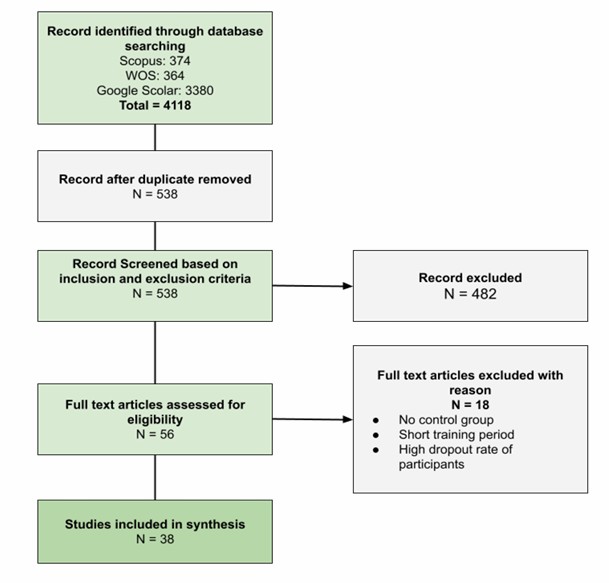
Purpose: The present meta-analysis aimed to evaluate the effects of gymnastics-based interventions on motor fitness competencies across different age groups, including children, adolescents, and young adults. Methods: A systematic search was conducted to identify randomized controlled trials examining the impact of gymnastics-based training modalities, including fundamental movement skills, coordination training, balance/proprioceptive training, and physical conditioning. A total of 38 studies were included in the analysis. Effect sizes were calculated using standardized mean differences (SMD) under a random-effects model. Heterogeneity was assessed using I² statistics, and subgroup analyses were performed based on motor fitness components, age groups, and intervention types. Publication bias was evaluated using funnel plot asymmetry tests, Egger’s test, Trim and Fill method, and Fail-Safe N. Results: The overall pooled effect size indicated a moderate positive effect (SMD = 0.626; 95% CI: 0.086 to 1.165) with high heterogeneity (I² = 95.76%). Subgroup analysis revealed that balance (SMD = 1.534), coordination (SMD = 0.900), and flexibility (SMD = 0.818) showed relatively higher improvements, while muscular strength demonstrated a smaller but significant effect (SMD = 0.351). In contrast, agility (SMD = −1.124) and reaction time (SMD = −4.114) showed inconsistent or negative effects, likely due to differences in measurement direction. Among age groups, children showed the highest effect (SMD = 1.189), whereas young adults showed a more stable moderate effect (SMD = 0.513). Gymnastics-based training demonstrated consistent outcomes with low heterogeneity (I² = 11.34%). Publication bias assessment showed non-significant asymmetry in Egger’s test (p = .657), while the Trim and Fill method adjusted the effect size to SMD = 0.084 (p = .734). The Fail-Safe N (2160) indicated high robustness of the findings. Conclusions: Gymnastics-based interventions are effective in improving motor fitness competencies, particularly flexibility, balance, and coordination. However, the presence of high heterogeneity, methodological variability, and potential publication bias suggests that the results should be interpreted with caution. Future research should focus on standardized measurement approaches and high-quality trials to strengthen the evidence base.

Downloads
References
Abdul Nabi Issa, S. (2016). Effect of Developing Coordination Abilities on Improving Performance Level for Gymnastics for All Shows Players. In Journal of Applied Sports Science (Vol. 6, Number 1).
Altinkök, M. (2016). The Effects of Coordination and Movement Education on Pre School Children’s Basic Motor Skills Improvement. Universal Journal of Educational Research, 4(5), 1050–1058. https://doi.org/10.13189/ujer.2016.040515
An, K.-O., & Lee, K.-J. (2021). Sports Injury Prevention and Functional Training: A Literature Review. The Asian Journal of Kinesiology, 23(1). https://doi.org/10.15758/ajk.2021.23.1.46
Boraczyński, T., Boraczyński, M., Boraczyńska, S., & Michels, A. (2013). Changes in body composition and physical fitness of 7-year-old girls after completing a 12-month artistic gymnastics training program. Human Movement, 14(4), 291–298. https://doi.org/10.2478/humo-2013-0034
Brakke, K., & Pacheco, M. M. (2019). The Development of Bimanual Coordination Across Toddlerhood. Monographs of the Society for Research in Child Development, 84(2). https://doi.org/10.1111/mono.12405
Chetcuti, L., Uljarević, M., Schuck, R. K., Hardan, A. Y., Gengoux, G. W., Trembath, D., Vadgama, Y., Varcin, K. J., Vivanti, G., Whitehouse, A. J. O., Helton, M., & Frazier, T. W. (2025). Characterizing predictors of response to behavioral interventions for children with autism spectrum disorder: A meta-analytic approach. In Clinical Psychology Review (Vol. 119). https://doi.org/10.1016/j.cpr.2025.102588
Dallas, G., Kirialanis, P., & Mellos, V. (2014). The acute effect of whole-body vibration training on flexibility and explosive strength of young gymnasts. Biology of Sport, 31(3), 233–237. https://doi.org/10.5604/20831862.1111852
Dallas, G., Theodorou, A., & Paradisis, G. (2019). The effect of different duration of dynamic stretching on sprint run and agility test on female gymnast. Journal of Physical Education and Sport, 19, 268–272. https://doi.org/10.7752/jpes.2019.s1040
Dobrijević, S. M., Moskovljević, L., Marković, M., & Dabović, M. (2018). Effects of Proprioceptive Training on Explosive Strenght, Aglility and Coordination of Young Rhythmic Gymnasts. https://doi.org/10.5937//zkul1801071D
Dönmez, V., & Bavlı, Ö. (2020). Investigation of the Effect of Eight Weeks Gymnastic Training on Biomotor Skills of Children. Gymnasium, 21(1), 42–49. https://doi.org/10.29081/gsjesh.2020.21.1.04
Dudley, R. W. R., Parolin, M., Gagnon, B., Saluja, R., Yap, R., Montpetit, K., Ruck, J., Poulin, C., Cantin, M. A., Benaroch, T. E., & Farmer, J. P. (2013). Long-term functional benefits of selective dorsal rhizotomy for spastic cerebral palsy: Clinical article. Journal of Neurosurgery: Pediatrics, 12(2). https://doi.org/10.3171/2013.4.PEDS12539
Esteban-García, P., Jiménez-Díaz, J. F., Abián-Vicén, J., Bravo-Sánchez, A., & Rubio-Arias, J. (2021). Effect of 12 Weeks Core Training on Core Muscle Performance in Rhythmic Gymnastics. Biology 2021, Vol. 10, 10(11). https://doi.org/10.3390/biology10111210
Gallotta, M. C., Franciosi, E., Giorgi, M., Guidetti, L., Cerbara, E., Pes, G., Silvestri, F., & Curzi, D. (2024). Benefits of inclusive sport training on fitness and health of athletes with and without intellectual disability. Scientific Reports, 14(1). https://doi.org/10.1038/s41598-024-69334-2
Genc, H., & Kizar, O. (2020). Effects of Gymnastics on Static and Dynamic Balance in Children (Bingol Province Sample). Journal of Education and Learning, 9(2), 211. https://doi.org/10.5539/jel.v9n2p211
Germic, A. (2025). Reactive and Pre-planned Agility in Young Tennis Players. Baltic Journal of Sport and Health Sciences, 1(134). https://doi.org/10.33607/bjshs.v1i134.1571
Gonçalves, C., Bezerra, P., Clemente, F. M., Vila-Chã, C., Leão, C., Brandão, A., & Cancela, J. M. (2021). Balance control in artistic gymnasts and its comparison under three training methods: a pilot trial. Human Movement, 23(2), 56–64. https://doi.org/10.5114/HM.2021.106167
Hassan, A. K., Alhumaid, M. M., & Hamad, B. E. (2022). The Effect of Using Reactive Agility Exercises with the FITLIGHT Training System on the Speed of Visual Reaction Time and Dribbling Skill of Basketball Players. Sports, 10(11). https://doi.org/10.3390/sports10110176
Kaioglou, V., Kouloutbani, K., & Venetsanou, F. (2025). Developing children’s physical literacy in sport: evaluation of a theory-based physical literacy intervention in gymnastics. Physical Education and Sport Pedagogy. https://doi.org/10.1080/17408989.2025.2533799
Kristofic, J., Malý, T., & Zahálka, F. (2018). The effect of intervention balance program on postural stability. Science of Gymnastics Journal, 10(1), 17-27.
Li, M. (2024). Research on the application of biomechanics analysis in optimizing physical education movement techniques. MCB Molecular and Cellular Biomechanics, 21(3). https://doi.org/10.62617/mcb496
Li, W., & Rukavina, P. (2012). The nature, occurring contexts, and psychological implications of weight-related teasing in urban physical education programs. Research Quarterly for Exercise and Sport, 83(2). https://doi.org/10.1080/02701367.2012.10599862
Ma, S., Soh, K. G., Japar, S. B., Liu, C., Luo, S., Mai, Y., Wang, X., & Zhai, M. (2024). Effect of core strength training on the badminton player’s performance: A systematic review & meta-analysis. PLoS ONE, 19(6 June). https://doi.org/10.1371/journal.pone.0305116
Mclaren, L., Sumar, N., Barberio, A. M., Trieu, K., Lorenzetti, D. L., Tarasuk, V., Webster, J., & Campbell, N. R. C. (2016). Population-level interventions in government jurisdictions for dietary sodium reduction. In Cochrane Database of Systematic Reviews (Vol. 2016, Number 9). https://doi.org/10.1002/14651858.CD010166.pub2
Morewedge, C. K., & Buechel, E. C. (2013). Motivated underpinnings of the impact bias in affective forecasts. Emotion, 13(6). https://doi.org/10.1037/a0033797
ÖZER, Ö., & SOSLU, R. (2019). Comparison of the Static Balance, Strength and Flexibility Characteristics of the University Students Who Taken Artistic Gymnastic Lesson. Turkish Journal of Sport and Exercise, 229–233. https://doi.org/10.15314/tsed.573516
Özer, Ö., & Soslu, R. (2019). The Effects of Specific Stretching Exercises on Flexibility and Balance Parameters in Gymnastics. Journal of Education and Learning, 8(5), 136. https://doi.org/10.5539/jel.v8n5p136
Özer, Ö., Soslu, R., Devrilmez, E., Uyhan, O., Devrilmez, M., & Dogan, I. (2024a). The Effects of Gymnastics Training on Flexibility And Strength In Children. Science of Gymnastics Journal, 16(2), 289–304. https://doi.org/10.52165/sgj.16.2.289-304
Özer, Ö., Soslu, R., Devrilmez, E., Uyhan, O., Devrilmez, M., & Dogan, I. (2024b). The Effects of Gymnastics Training on Flexibility And Strength In Children. Science of Gymnastics Journal, 16(2), 289–304. https://doi.org/10.52165/sgj.16.2.289-304
Rehab Hafez, A. (2016). Impact of Coordination Abilities Program on Accuracy and Speed In Rhythmic Gymnastics. In Romania the journal is indexed in: Ebsco, SPORTDiscus, INDEX COPERNICUS JOURNAL MASTER LIST: XVI (Number 2).
Saini, P., Singh, D. K., Reddy, T. O., & Singh, V. (2023). Effects of Various Gymnastic Exercises on Selected Motor Fitness Components of School Students. IJFMR, 5(3). https://doi.org/10.36948/ijfmr.2023.v05i03.3420
Samokysh, I., Shanditseva, P., Hurenko, A., Olenych, I., Chekhovska, O., & Svitlakov, Y. (2025). Assessment of physical ability of students: from classic tests to innovative approaches. Scientific Journal of National Pedagogical Dragomanov University. Series 15. Scientific and Pedagogical Problems of Physical Culture (Physical Culture and Sports), (9(196)), 186–189. https://doi.org/10.31392/UDU-NC.SERIES15.2025.09(196).36
Samokysh, I., Shanditseva, P., & Samokysh, V. (2025). Modern approaches to physical rehabilitation of adolescents aged 13-15 with postural disorders. Scientific Journal of National Pedagogical Dragomanov University. Series 15. Scientific and Pedagogical Problems of Physical Culture (Physical Culture and Sports), (8(195)). https://doi.org/10.31392/udu-nc.series15.2025.08(195).27
Shaikh, G. I., & Singh, B. (n.d.). Impact of gymnastic training on health related physical fitness of women softball players. 7(6), 110–113. Retrieved www.allresearchjournal.com
Shkola, O., Makotchenko, O., & Sychov, D. (2025). features of teaching methods using health -improving and recreational technologies in the process of classes with students of the specialty 017 physical culture and sports. Sport Science and Human Health, (1), 236–248. https://doi.org/10.28925/2664-2069.2025.120
Talla Ahmed Saad Ahmed, A. (2024). The impact of coordination abilities in improving the level of skill performance in national development for aerobic gymnasts under 11 years old (Vol. 14, Number 2). www.jass.alexu.edu.eg
Taufiqurrahman, T. F., Tirtawirya, M.Or, Dr. D., & Rahaman Ayudi, A. (2022). The Effect of Sprint Exercise on Stairs and Clips on Increasing Limb Power in Aerobic Gymnastic Athletes. International Journal of Multidisciplinary Research and Analysis, 05(12). https://doi.org/10.47191/ijmra/v5-i12-28
Trajkovic, N., Madic, D., Sporis, G., Aleksic-Veljkovic, A., & Živcic-Marković, K. (2016). Impact of gymnastics program on health-related fitness in adolescent pupils. Science of Gymnastics Journal, 8(2), 157-166.
Vlasic, G. (2023). Comparative analysis of the role of strategic orientation, strategic performance metric focus and strategic audacity in driving firm performance: family businesses vs nonfamily businesses. Journal of Family Business Management, 13(1). https://doi.org/10.1108/JFBM-03-2022-0048
Wang, L. (2024). Selected Specific Physical Training Program to Improve Jump Ability for Aerobic Gymnastic. International Journal of Sociologies and Anthropologies Science Reviews, 4(6), 249–256. https://doi.org/10.60027/ijsasr.2024.4693
Zeynesh, B. (2025). “Tasks for Gymnastic Equipment.” Eurasian Science Review an International Peer-Reviewed Multidisciplinary Journal, 1(3). https://doi.org/10.63034/esr-399
Downloads
Published
Issue
Section
License
Copyright (c) 2026 Vikram Nehra, Himanshu, Yogita, Satish Kumar, Priyanka, Ankit Sharma, Naveen Sangwan, Rohit Rathee, Atul Saharan

This work is licensed under a Creative Commons Attribution 4.0 International License.