Analysis the Influence of Geographical, Socioeconomic, Digital Technology, and Cultural in the Development of Preschool Children's Motor Skills
DOI:
https://doi.org/10.60081/SSHA.4.1.2026.587-595Keywords:
- Childhood,
- Motor Skills,
- MOBAK-KG
Abstract
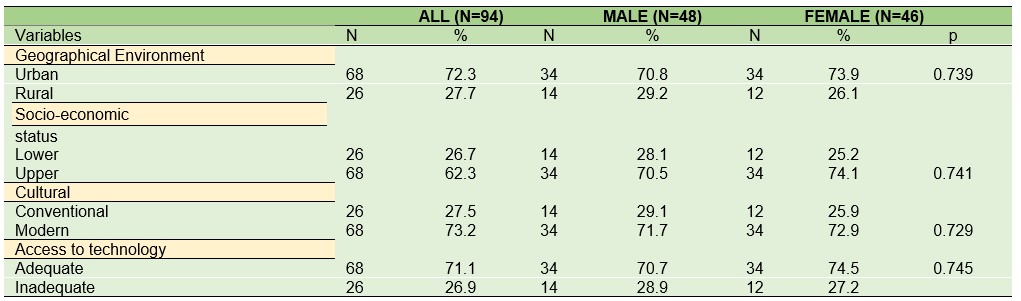
Background: hildren's motor development can be influenced by factors including geographic location, socioeconomic status, access to technology, and local cultural conditions. Understanding these relationships is critical to designing effective interventions and strategies to optimize child development. Purpose: The aim of this research is to analyze the influence of geographic location, socio-economic status, use of technology on the basic motor skills of children aged 3-5 years. Material and Methods: A group of 94 children in South Kalimantan province aged between 3 and 5 years. Data collection was carried out in 8 different schools, and motor skills were assessed using the MOBAK-KG test to assess basic motor competence (BMC) in kindergarten and one-factor analysis of variance (ANOVA) was used to determine whether the motor skills of preschool children differ based on their geographic location, socio-economic status, access to technology, and local cultural conditions. Results: This research shows that various external factors, such as geographic location, socioeconomic status, access to digital technology, and cultural background, influence the development of children's motor skills. Conclusion: Boys, especially in urban areas with higher socioeconomic status, access to digital technology, and modern cultural background, show better performance. Girls showed fewer differences, although some girls from rural areas with lower socioeconomic status and conventional cultural backgrounds excelled in certain skills such as “Jumping” and “Throwing”.

Downloads
References
Adolph, K. E., & Hoch, J. E. (2020). The Importance of Motor Skills for Development. Nestle Nutrition Institute Workshop Series, 95, 136–144. https://doi.org/10.1159/000511511
Aye, T., Oo, K. S., Khin, M. T., Kuramoto-Ahuja, T., & Maruyama, H. (2017). Gross motor skill development of 5-year-old Kindergarten children in Myanmar. Journal of Physical Therapy Science, 29(10), 1772–1778. https://doi.org/10.1589/jpts.29.1772
Baghwanji, Yash; Santos, Rosa Milagros; Fowler, S. A. (2000). Culturally & Linguistically Sensitive Practices in Motor Skills Intervention for Yong Children. The Early Childhood Research Institute on Culturally and Linguistically Appropriate Services (CLAS), April 2000, 46p. https://doi.org/voice/try 1.800/583.4135
Bardid, F., Deconinck, F. J. A., Descamps, S., Verhoeven, L., De Pooter, G., Lenoir, M., & D’Hondt, E. (2013). The effectiveness of a fundamental motor skill intervention in pre-schoolers with motor problems depends on gender but not environmental context. Research in Developmental Disabilities, 34(12), 4571–4581. https://doi.org/10.1016/j.ridd.2013.09.035
Barrett, P., Treves, A., Shmis, T., Ambasz, D., & Ustinova, M. (2019). The Impact of School Infrastructure on Learning. In International Development in Focus.
Faira Zanada, J., Suhartini, B., Nasrulloh, A., Susanto, N., Cristina, C., & Lourenco, V. (2023). JOSSAE (Journal of Sport Science and Education) The Effectiveness of Play on Pre-School Motor Children. Journal of Sport Science and Education) |, 8.
Hassan, M. A., Zhou, W., Ye, M., He, H., & Gao, Z. (2024). The effectiveness of physical activity interventions on blood pressure in children and adolescents: A systematic review and network meta-analysis. Journal of Sport and Health Science, 13(5), 699–708. https://doi.org/10.1016/j.jshs.2024.01.004
Herrmann, C., Wälti, M., & Wacker, S. (2020). M O B A K - K G: Basic motor competencies in kindergarten.Test Manual. https://doi.org/10.5281/zenodo.3774438
Hunter, R. F., Cleland, C., Cleary, A., Droomers, M., Wheeler, B. W., Sinnett, D., Nieuwenhuijsen, M. J., & Braubach, M. (2019). Environmental, health, wellbeing, social and equity effects of urban green space interventions: A meta-narrative evidence synthesis. Environment International, 130(December 2018), 104923. https://doi.org/10.1016/j.envint.2019.104923
Jenny, S. E., Schary, D. P., Noble, K. M., & Hamill, S. D. (2017). The Effectiveness of Developing Motor Skills Through Motion-Based Video Gaming: A Review. Simulation and Gaming, 48(6), 722–734. https://doi.org/10.1177/1046878117738552
Joo, J. Y., & Liu, M. F. (2021). Culturally tailored interventions for ethnic minorities: A scoping review. Nursing Open, 8(5), 2078–2090. https://doi.org/10.1002/nop2.733
Kwon, S., & O’neill, M. (2020). Socioeconomic and familial factors associated with gross motor skills among us children aged 3–5 years: The 2012 nhanes national youth fitness survey. International Journal of Environmental Research and Public Health, 17(12), 1–14. https://doi.org/10.3390/ijerph17124491
Logan, S. W., Robinson, L. E., Wilson, A. E., & Lucas, W. A. (2012). Getting the fundamentals of movement: A meta-analysis of the effectiveness of motor skill interventions in children. Child: Care, Health and Development, 38(3), 305–315. https://doi.org/10.1111/j.1365-2214.2011.01307.x
Lopes, L., Santos, R., Coelho-E-Silva, M., Draper, C., Mota, J., Jidovtseff, B., Clark, C., Schmidt, M., Morgan, P., Duncan, M., O’Brien, W., Bentsen, P., D’Hondt, E., Houwen, S., Stratton, G., De Martelaer, K., Scheuer, C., Herrmann, C., García-Hermoso, A., … Agostinis-Sobrinho, C. (2021). A narrative review of motor competence in children and adolescents: What we know and what we need to find out. International Journal of Environmental Research and Public Health, 18(1), 1–20. https://doi.org/10.3390/ijerph18010018
Montayre, J., Neville, S., Dunn, I., Shrestha-Ranjit, J., & Wright-St. Clair, V. (2020). What makes community-based physical activity programs for culturally and linguistically diverse older adults effective? A systematic review. Australasian Journal on Ageing, 39(4), 331–340. https://doi.org/10.1111/ajag.12815
Morley, D., Till, K., Ogilvie, P., & Turner, G. (2015). Influences of gender and socioeconomic status on the motor proficiency of children in the UK. Human Movement Science, 44, 150–156. https://doi.org/10.1016/j.humov.2015.08.022
Page, Z. E., Barrington, S., Edwards, J., & Barnett, L. M. (2017). Do active video games benefit the motor skill development of non-typically developing children and adolescents: A systematic review. Journal of Science and Medicine in Sport, 20(12), 1087–1100. https://doi.org/10.1016/j.jsams.2017.05.001
Paul, C. D., Hansen, S. G., Marelle, C., & Wright, M. (2023). Incorporating Technology into Instruction in Early Childhood Classrooms: a Systematic Review. Advances in Neurodevelopmental Disorders, 7(3), 380–391. https://doi.org/10.1007/s41252-023-00316-7
Peralta, L. R., Mihrshahi, S., Bellew, B., Reece, L. J., & Hardy, L. L. (2019). Influence of School-Level Socioeconomic Status on Children’s Physical Activity, Fitness, and Fundamental Movement Skill Levels. Journal of School Health, 89(6), 460–467. https://doi.org/10.1111/josh.12761
Peyre, H., Hoertel, N., Bernard, J. Y., Rouffignac, C., Forhan, A., Taine, M., Heude, B., & Ramus, F. (2019). Sex differences in psychomotor development during the preschool period: A longitudinal study of the effects of environmental factors and of emotional, behavioral, and social functioning. Journal of Experimental Child Psychology, 178, 369–384. https://doi.org/10.1016/j.jecp.2018.09.002
Power, M., Kennedy, S., Cleary, F., Mills, I., Kinsella, S., & Celdran, A. H. (2024). A Systematic Literature Review of XR Interventions to Improve Motor Skills Development Among Autistic Children. IEEE Access, 12(August), 108953–108974. https://doi.org/10.1109/ACCESS.2024.3438361
Shi, P., & Feng, X. (2022). Motor skills and cognitive benefits in children and adolescents: Relationship, mechanism and perspectives. Frontiers in Psychology, 13(November), 1–14. https://doi.org/10.3389/fpsyg.2022.1017825
Staiano, A. E., Newton, R. L., Beyl, R. A., Kracht, C. L., Hendrick, C. A., Viverito, M., & Webster, E. K. (2022). mHealth Intervention for Motor Skills: A Randomized Controlled Trial. Pediatrics, 149(5). https://doi.org/10.1542/peds.2021-053362
Sutapa, P., Pratama, K. W., Rosly, M. M., Ali, S. K. S., & Karakauki, M. (2021). Improving motor skills in early childhood through goal-oriented play activity. Children, 8(11), 1–11. https://doi.org/10.3390/children8110994
Van der Walt, J., Plastow, N.A. & Unger, M. (2020). Motor skill intervention for pre-school children: A scoping review. African Journal of Disability, 9(0), a747. https://doi.org/https://doi.org/10.4102/ajod.v9i0.747
Wong, R. S., Tung, K. T. S., Chan, B. N. K., Ho, F. K. W., Rao, N., Chan, K. L., Sun, J., So, H. K., Wong, W. H. S., Tso, W. W. Y., Yam, J. C. S., Wong, I. C. K., & Ip, P. (2022). Early-life activities mediate the association between family socioeconomic status in early childhood and physical fitness in early adolescence. Scientific Reports, 12(1), 1–10. https://doi.org/10.1038/s41598-021-03883-8
Xia, X., Chao, L., Nan, C., Yin, X., Zheng, H., & Zhang, S. (2022). Fundamental motor skills of kindergarten children in different environments and ethnic groups in Northwest China. BMC Pediatrics, 22(1), 423. https://doi.org/10.1186/s12887-022-03497-7
Zulrafli, & Kamarudin. (2021). The analysis of motor ability of physical education students (pp. 1–9). Journal Sport Area. https://doi.org/https://doi.org/10.25299/sportarea.2021.vol6(1).4097
Downloads
Published
Issue
Section
License
Copyright (c) 2026 Sulfi Mayang, Aulia Putri Yuliasti, Ahmat Fauzi

This work is licensed under a Creative Commons Attribution 4.0 International License.